


4 days ago3 min read


5 days ago4 min read


5 days ago4 min read

Can you see the guitar in this work? It isn't drawn. It's formed by the empty space between the tree branches, and the two hummingbirds' beaks are the strings. If you don't look for it, you won't see it. Once you see it, you can't unsee it.
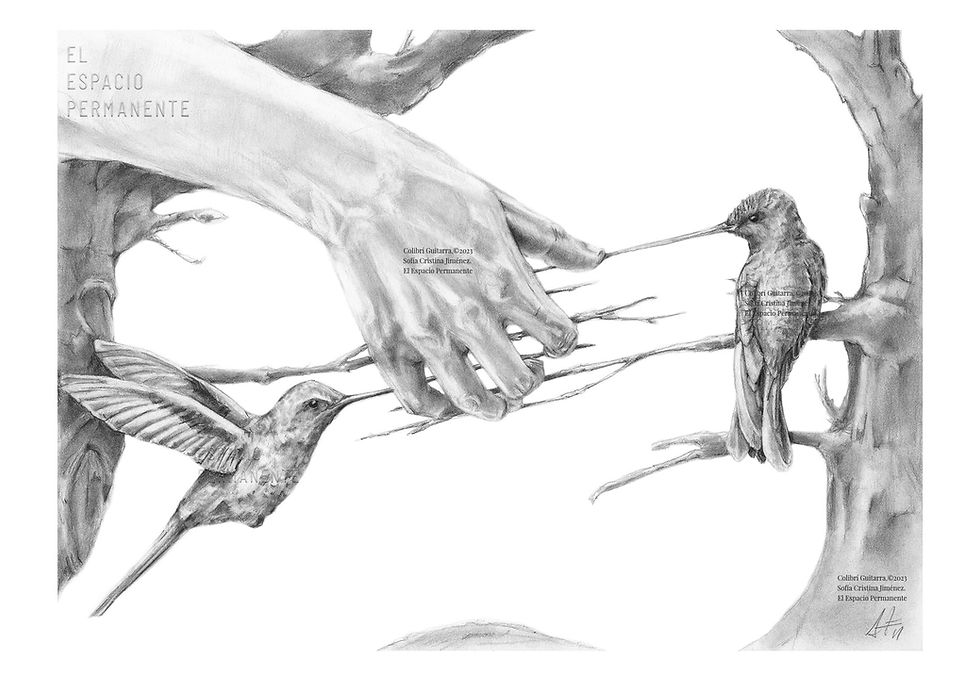
That is visual poetry: an image that says something words alone couldn't say. And that changes depending on who's looking.
Visual poetry has a long history: from Apollinaire's calligrams to Joan Brossa's visual poems, through Brazilian concrete poetry. But it has almost always been understood as a literary genre: text becoming image. What I do is the reverse: images that contain poems, drawings that hide a handwritten text. I don't come from poetics or the tradition of the visual poet. I come from painting.
In my practice, visual poetry is not a decorative device. It is the reason I make each work. I always start from an image-concept something that condenses a complex idea into a single gesture, without needing explanation. And in many pieces I also add a handwritten poem of my own, because sometimes image and word need each other to close the meaning. Not to explain but to multiply.
Las obras
In Colibrí Guitarra, the guitar doesn't exist as an object. It's built by the space between the branches, and the birds' beaks are the strings. Two forms of vibration - wing and string - merged into a single figure. The poem doesn't describe what you see either. It completes it:
| Lightness of the hummingbird | on the strings of my guitar.
In Gulliver, I took Swift's character and rewrote it from the female body. A woman begins to rise despite small beings trying to hold her down with ropes. Swift's scene, the giant tied down by the Lilliputians but here, the one rising is her. The poem doesn't describe the struggle. It turns it into something universal:
The most beautiful thing about a body is its ability to rise. always.©

Solid Tide carries the contradiction in its title: a boat stranded on the ice rocks of a whisky on the rocks. What should float, stranded. What should be liquid, solid. The irony completes the image:
I'll have a boat on the rocks, please!
The unravelling is the work I've been asked about most. A hand pulls a rope of esparto that wraps around a seated figure. But when you follow the arm downward, there is no wrist. No body to complete that hand. The question the work plants is: is there someone there, or just knots shaped like a person? I don't answer. That uncertainty is the work. Selected for the IX Salón de Dibujo, Grabado e Ilustración 2024:
Is there even a body?
or just turns, tangles and knots of esparto?
Sometimes, all you can do is wait for the | unravelling |.©
In Trueno Casero, a girl is trapped inside a glass jar. On the jar you can read: Trueno Casero (Homemade Thunder) . What should be outside : the storm, the roar, the uncontrollable is inside, stored, domestic. But the poem flips what seems like a limitation:
| Don't tear me from my inner thunder | for within it lies my silence.©
Dinero Dios is a dollar bill with a Pantocrator icon where the president should be. Drawn in graphite with almost obsessive precision. Two systems of value -economic and spiritual- in the same image. The poem doesn't soften the critique:
When the false god lost his money, he went back to praying:
to the one who blesses but never prays.©
In Viento del Desierto, I painted the Winged Victory of Samothrace emerging from desert sands. A sculpture ( something already still, already stone) wrapped in wind and sand. The paradox is that resistance doesn't come from lightness but from solidity. The wings are made of stone, and that's why they hold:
| This desert wind ,don't fear it, it's only sand, and your wings are made of stone. |©

Ave Cerámica is a white peacock turned into a statue on a column. Beauty that gives up being alive in order to be preserved. A single verse says it all:
| To preserve her beauty, she begged to become carving. |©
In the Botanical Aquarium I work in watercolor: each fish has a fin transformed into a botanically documented flower. The fusion of two natural kingdoms in a single being. Each print carries the handwritten verse of the series:
| When fauna becomes flora, an ocean blooms. |©
Read how this series was born here.
I'm currently working on a new series that takes visual poetry into another territory: garden landscapes inspired by Fragonard, inhabited by carnivorous plants. Fragonard painted desire as scenography perfect gardens, golden light, swaying bodies. I put the devouring plants inside. Rococo beauty as a trap. Ornament that hungers. Beauty and danger in the same gesture.
In a world saturated with images consumed in seconds, with disposable aesthetics, I'm interested in making works that don't run out on the first glance. That change depending on who's looking. That need to be deciphered.
For me, a work of art must stand on its own without title, without explanation and at the same time gain layers when you know the context. That is what separates a decorative illustration from visual art, from a work of contemporary art. And it's what I try to do in every piece at El Espacio Permanente.
If you want to see all available works in detail, you can do so here. And if you want to know more about my practice and career, here is my biography.
If you're interested in watercolor prints, you might also like this.
♡♡♡
© Content protected by copyright. 2026 El Espacio Permanente · Sofía Cristina Jiménez. All rights reserved. Total or partial reproduction of this content without express authorisation is prohibited. Images and texts on this blog are the property of El Espacio Permanente.
Follow us on


Comments